Disclaimer: The following guide is my best guess on what content will be on the exam. I do not know what exactly will be on the exam but I have helped over a thousand health care professionals pass the exam.
Chapter 5- Reducing the Risk of Developing Diabetes
Importance: High- Re-read a few times, be familiar with chapter-
Approximate time recommended: 60 min
I have highlighted what I think will be important for the exam. All areas in grey (key messages and recommendations) are also important for the exam. However you should read the entire chapter.
 Loading...

 Reload document
  Open in new tab
 Under the heading of: Reducing the Risk of Developing Type 1 Diabetes
The main message is that we don’t have enough information/agreement of information to recommend anything in particular for preventing type 1 diabetes (just like in screening for type 1 diabetes). There are some updates to this in the American Guidelines. Please see the end of chapter for details.
Reducing the Risk of Developing Type 2 Diabetes
Type 2 diabetes costs the healthcare system a lot of money. We could save a lot of money by preventing the development of type 2 diabetes. This is where you can apply your knowledge by giving patients clear facts and encouraging/guiding them with lifestyle changes.
Healthy Behaviour Interventions
Lifestyle changes can have a powerful effect in reducing the progression from pre-diabetes to type 2 diabetes. Several studies show the diet, exercise and weight loss of 5% can reduce the progression by ~60% which is a more powerful effect than some medications! Metformin reduce the progression by about 30-40% and acarbose by ~30% so lifestyle changes were roughly twice as effective. I find that when patients hear that there could be a ~60% risk reduction in them progression from pre-diabetes to type 2 diabetes they get excited as 60% is a big number. This is a great time to set reasonable goals, give guidance and establish follow up with patients with pre-diabetes.
Medical Nutrition Therapy
Dietitians interventions has been shown to reduce the progression of pre-diabetes to type 2 diabetes
Dietary Patterns
Be familiar with the Mediterranean and the DASH diet. It will be further explained in the Chapter 11.
Physical Activity
These studies established the recommended goal of 150 min/week of physical exercise.
Under the heading of: Pharmacotherapy
Metformin reduces the progression by ~30%. It seems to work better on people who are younger and/or obese
Thiazolidinediones like Rosiglitazone (Avandia) and Pioglitazone (Actos) showed significant reductions in progression from 60-70%. However rosiglitazone is not used much more anymore because one study found that it may increase cardiovascular events, it will likely not be on the exam. Pioglitazone also has many side effects such as weight gain, possible bladder cancer and increased fractures so is falling out of favor but will likely still be on the exam.
Acarbose (Glucobay) showed reductions of progression by ~30%
Orlistat (Xenical) is a medication for weight loss (not diabetes) that inhibits fat absorption causing diarrhea and steatorrhea (fat in feces). Its poorly tolerated unless the patient is strict with their diet. However for patients who were able to stick with this medication, orlistat reduces progression by ~30-40%
Patients with obesity taking Liraglutide (Victoza) took 2.7 times longer to develop diabetes.
Vitamin D had not effect.
Bariatric Surgery
Since all surgery has it’s risks the risk/benefit ratio of bariatric surgery for diabetes prevention is unclear
Diabetes Prevention in High-Risk Ethnicities
People with African, Arab, Asian, Hispanic, Indigenous and South Asian ethnicities are at higher risk for diabetes (I find it easier to remember the list as non-Caucasian).
Population Level Interventions for Prevention of Type 2 Diabetes
The incidence of diabetes has been increasing due to several factors and are complex. Be familiar with Figure 1 .
Practice Questions (press show answer to reveal answer)
Which of the following does not help with preventing the progression of pre-diabetes to type 2 diabetes
A) Nicotinamide
B) Pioglitazone
C) Orlistat
D) Acarbose
Remember to look out for NOT questions on the exam. I want you to pass and suggest that whenever you see the word NOT or which if the following is INCORRECT or EXCEPT that you circle it. That will remind you to look for the not true or incorrect answer instead of the correct one.
A) Correct- Nicotinamide was used in trials for prevention of type 1 diabetes (not type 2 diabetes) but had no effect
B) Incorrect- Pioglitazone does help with preventing progression
C) Incorrect- Orlistat does help with preventing progression
D) Incorrect- Acarbose does help with preventing progression
Material that is relevant to your practice but may not be on the exam below:
I am not sure if Tzield (teplizumab) will be on the exam because its such a specialty medication. Tzield came out in the summer of 2025, and is a monoclonal antibody infusion for the delay of type 1 diabetes. It is a one time infusion that delays the onset of type 1 diabetes by about two years. It is administered once daily for five days. It should be administered in Stage 2 type 1 diabetes. Staging is not discussed in the Canadian guidelines so please see the below diagram for additional information.
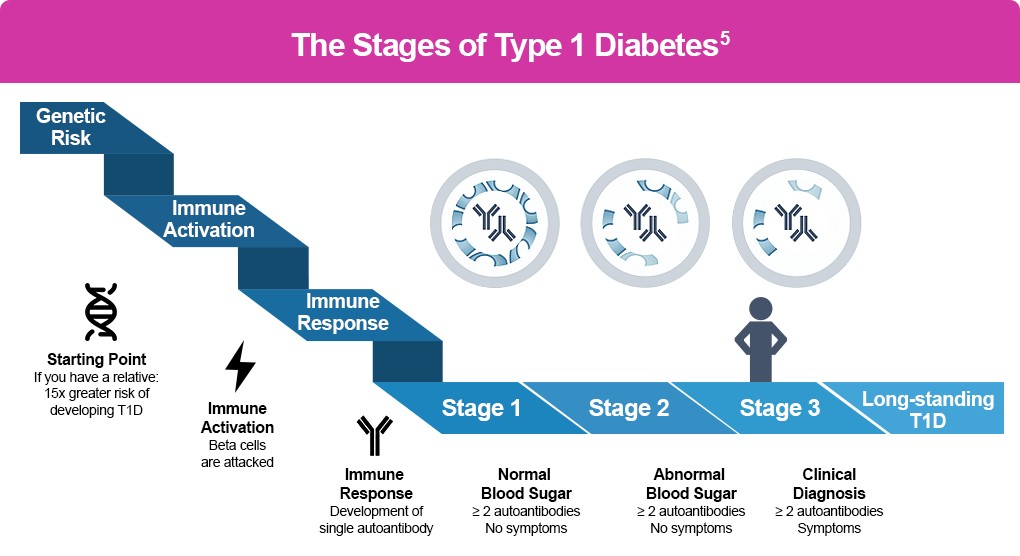
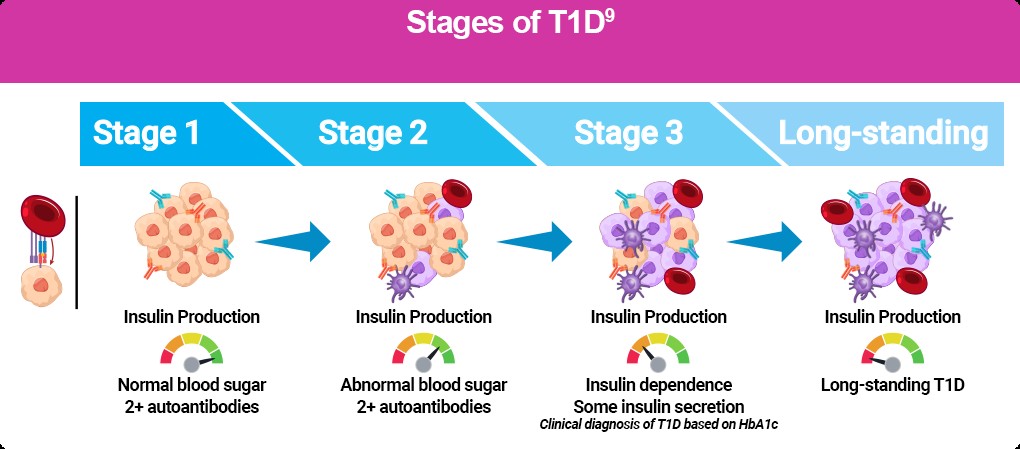
Tzield is used in stage 2 where there is 2+ autoantibodies and insulin product has started to be diminished leading to abnormal blood sugars. The four antibodies we are looking for are GAD, ZnT8A, IAA and 1A-2A. If there are more than two of these antibodies present than the person is very likely to develop Type 1 diabetes. Unfortunately in most provinces I believe we can only order GAD. For a limited time we can order test kits at no-charge to test eligible people for type 1 diabetes from the UncoverT1D program-https://www.revvity.com/ca-en/category/autoimmune-type-1-diabetes-early-detection-program . From their website eligible people include:
- First-degree relatives (FDR) and second-degree relatives (SDRs) of someone with aT1D, such as a parent, sibling, child, grandparent, cousin
- Patients diagnosed with any autoimmune condition, particularly celiac disease and thyroid disease
- Those with a family history of autoimmune diseases
- Patients who may have been previously diagnosed with type 2 diabetes or pre-diabetes, but their clinical features or response to treatment could suggest autoimmune T1D9
- Screening in the general population, especially children, will help identify people with pre-symptomatic disease but no family history of aT1D or autoimmune disease. This is important, given that 90% of autoimmune T1D cases are in individuals without a family history of diabetes.
- Lower risk of DKA at diagnosis
- Reduced emotional burden
- Opportunity for parents and caregivers time to prepare for disease progression
- Fewer long-term complications, including hypoglycemia, retinopathy, nephropathy, and neuropathy
- Improve access to care, including opportunity to participate in future intervention trials
I want to share some real life experience with this. I was working in a family physician’s office when the physician pulled me aside to open up a sample blood glucose machine to test a child’s random sugar in the clinic. In the examining room there was a very sick looking child who looked grey, like a statue, and a very anxious mother. I tested the child’s sugar and it was 22 mmol/L. We told the mother that the child likely has type 1 diabetes and that we would call Children’s hospital to prepare a spot in emergency for them. At the point the mother got overwhelmed and starting crying, as did the child. A very stressful situation for both of them.
Now contrast this with what could have happened if the child was screened. I have a patient with type 1 diabetes who has the cutest boys, who are five and seven years old. The boys were negative for the antibodies which was a relief for the mom but imagine that one was positive. Then the mom could teach the child, over time, that mom uses needles for insulin and that he would need them someday too and not to be afraid. An endocrinologist and lab work could be arranged ahead of time. When the child’s sugars starting rising, low dose insulin could be considered to prevent DKA. It would be a smooth transition with both mother and child knowing what to expect next. Contrast that to the situation in the paragraph above. You could be that difference.
I’ve only used the kits twice but I am gaining experience with them. I will post any additional tips I find here. Being a pharmacist in Alberta, I can order the labs and sign all the forms. If you can’t do this, review the info and website with the patient and get their physician to do all the paperwork. Saves you from from doing all that hassle.
The other links to the program are:
There are more of these monoclonal antibodies being researched and coming out in the USA. I would expect to see more and more of these type of medications with time.